 ZH
ZH  EN
EN 
In the plastics industry, single screw extruders and twin screw extruders are the main two types of extrusion equipment. After looking at the difference between single screw and twin screw extruder in structure, application and function, you will better choose based on your needs.
Extruder Comparison in Structure and Application
About Single Screw Extruder
- Core Structure: One single screw rotates inside a cylindrical barrel. It with high shear, primarily generated in the narrow gap between the screw flight and the barrel.
- Application: Basic shape forming/processing. Including pipes, profiles, sheets/plates, blown/cast film, filaments, ropes, pelletizing (for general plastics with moderate homogenization demands)
About Twin Screw Extruder
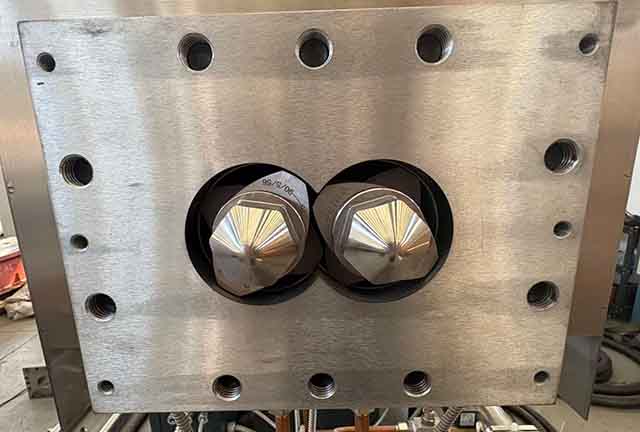
- Core Structure: Two intermeshing screws rotate inside a figure-eight (“∞”) shaped barrel. It can control the shearing strength at high, medium or low levels by combining different screw elements.
- Extruder Screw Types: There are two types of twin screw extruder, intermeshing and non-intermeshing. And, Intermeshing twin screw extruders have two types: co-rotating and counter-rotating. Intermeshing twin screw extruders is the most widely used type in plastics processing, especially for high mixing. It has excellent self-cleaning ability, the screws wipe each other in the intermeshing zone, effectively removing adhered material and preventing degradation.
- Application: High-performance or specialty material processing. Such as polymer blending (alloys), filling modification (e.g., calcium carbonate), fiber reinforcement (e.g., glass fiber), reactive extrusion, coloring, masterbatch production, processing heat-sensitive plastics (e.g., PVC), food, pharmaceuticals.
Functional Differences between Single Screw and Twin
1. Conveying and Plasticizing Ability
- Single Screw: Conveying efficiency is highly dependent on the material’s frictional properties (coefficient against the screw and barrel). Efficiency drops significantly with powders, low-friction materials, or slippery compounds, potentially causing feed issues. Plasticizing uniformity is relatively poorer.
- Twin Screw: Positive displacement ensures high, stable, and consistent conveying. It’s not affected by material form in pellets/powder or frictional characteristics. Plasticizing is more uniform and efficient.
2. Mixing and Dispersing Ability
- Single Screw: Not suitable for applications need high homogenization effect, high-filler loading, fiber reinforcement, or compounding tasks. It normally add mixing elements of pins, barrier flights, etc for improvement.
- Twin Screw: Mixing effect is core strength. It can precisely control shearing strength and mixing degree by combining various screw elements, achieving excellent distributive and dispersive mixing. It is the ideal equipment for plastic compounding and modification.
3. Residence Time Distribution
- Single Screw: Wider distribution of residence time. Some material may stay too short with poor plasticizing or too long cause thermal degradation.
- Twin Screw: Narrow distribution of residence time. Nearly all material undergoes an identical processing history, which is critical for processing heat-sensitive materials.
How to Choose between Single and Twin Screw Extruder
Choosing an suitable extruder is a systematic decision that balances processing needs, initial investment, operating costs, product quality, and future expanding. You can find helpful advice below or contact our experts for a suitable solution and specifications.
Processing Requirements
Single screw extruder is economical, efficient and reliable when you use standard plastic pellets of PE, PP, PS, etc. Meanwhile, your process mainly focuses on melting, homogenizing, and shaping without complex formulation mixing.
But twin screw extruder is leading when your processing involves in the following:
- Use powder raw material.
- Require high percentage of filler (e.g., calcium carbonate, talc).
- Add glass fibers or other reinforcing materials.
- Blending two or more polymers to create alloys.
- Conduct chemical reactions during extrusion (e.g., polymerization, grafting).
- Process heat-sensitive materials (e.g., PVC) requiring precise temperature control and short residence time.
- Have extremely high demands for product uniformity and consistency.
Investment Budget And Operation Cost
There is no best equipment, but only the one that best fits your needs and budget currently. It’s wise to spend every penny on solving your core problems.
- Single Screw: Simple structure, lower manufacturing and maintenance costs, and relatively lower energy consumption.
- Twin Screw: It has a complex structure and needs high precise design and manufacturing. This leads to a higher price, more maintenance costs, and greater energy consumption.
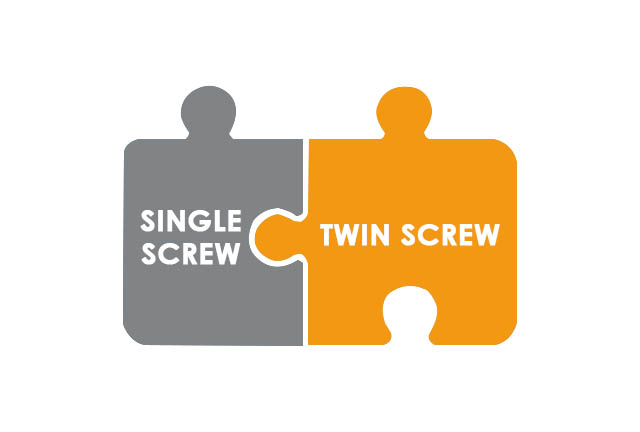
Single screw extruder is great at “extrusion and forming,” while twin screw extruder is excellent at “mixing and modifying.” It can combine this two extruders into a complete line in actual production to maximize the benefits of each. They have a complementary but not replaceable relationship, each playing an indispensable role in the modern plastics industry.